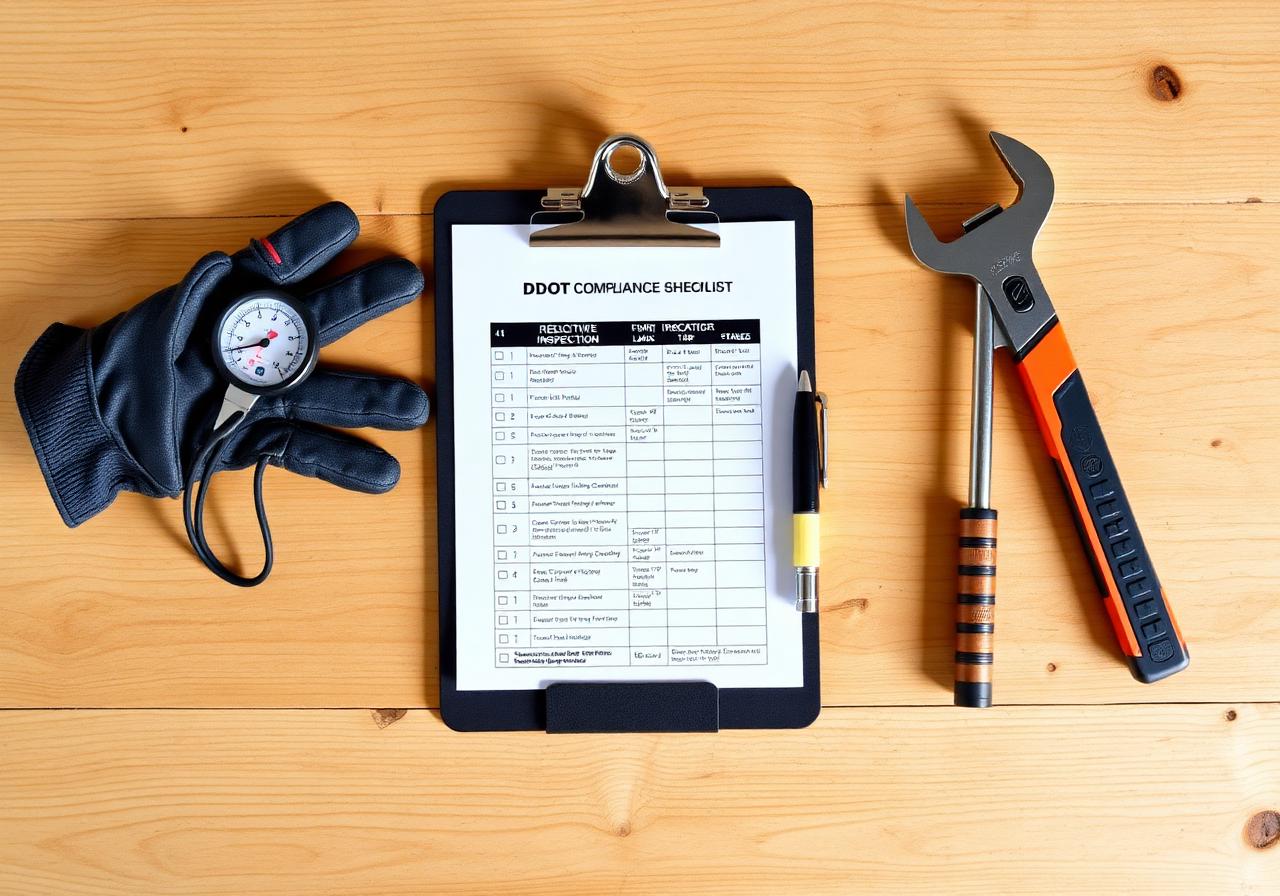
Most owner-operators we meet are doing their annual federal inspection late — sometimes weeks late — and with paperwork that wouldn't survive a level-one roadside check. Here's the checklist we walk every vehicle through, in the order an inspector reads it.
Brakes (the thing inspectors look at first)
Service-brake adjustment within tolerance, parking brake holds on grade, emergency-brake actuation tested. Air-brake systems get a full pressure-loss check (no more than 2 psi per minute static loss for a single vehicle, 3 psi for a combination).
Visible inspection of pads or shoes — at or above the manufacturer minimum. Rotor or drum surface condition documented with photos. Brake lines and chambers checked for chafe, leak, or improper mounting.
Coupling devices
If it's a combination unit, the fifth wheel gets close attention: mounting, pivot, kingpin engagement, secondary lock. We've seen otherwise well-maintained fleets miss subtle fifth-wheel wear that takes a vehicle out of service in seconds at a roadside check.
Suspension and steering
Leaf-spring leaf count and condition. Air-spring integrity. Shock absorbers attached and functional. Steering free play measured against manufacturer spec. Tie-rod ends, drag links, idler arms — every joint checked for wear.
Lighting, glass, and the easy stuff
Headlamps both high and low beam, marker lamps, identification lamps on combinations, tail and stop lamps, turn signals, reflectors. Windshield free of damage in the swept area. Wipers and washers functional.
These are the items that fail roadside inspections most often, simply because nobody checked them in the yard that morning.
Tires and wheels
Tread depth — 4/32 minimum on steer, 2/32 on others. Sidewall condition, no exposed cord or repair in the sidewall area. Wheel mounting hardware torqued and present. Mismatched casings on the same axle flagged.
— Alejandro Murillo